
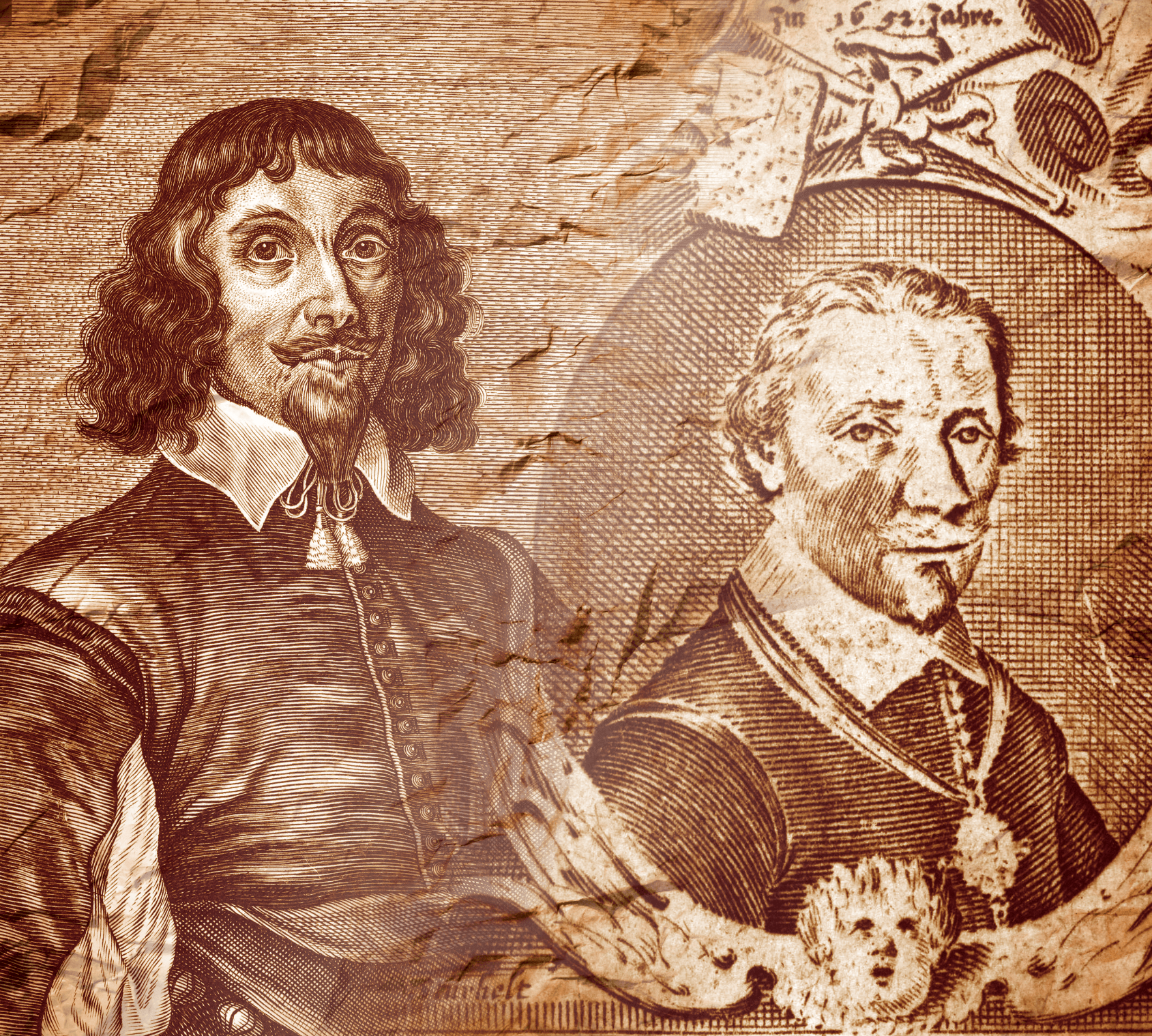
Scheidemann and Schop, from the Organ Loft
By David Yearsley
In size and power, the church organ dwarfs the violin. The two instruments might therefore seem unlikely, even irreconcilable duet partners, the one infamous in the popular imagination for a bombast that could easily overwhelm the other. Yet in seventeenth-century Hamburg, then Germany’s biggest city, the collaboration between organist Heinrich Scheidemann and the municipal violinist Johann Schop became one of the town’s leading cultural attractions. The pair played from the organ gallery of cavernous St. Catherine’s church to the delight of locals and tourists, colleagues and clerics, local grandees and townsfolk.
Scheidemann was renowned for his ability to express his lively humor while seated at the four manuals and pedals of St. Catherine’s organ, a massive color machine boasting impressive strength, but also equipped with a vibrant palette of registers imitating other instruments of the age: cornettos, viols, recorders. This organ was itself a giant cabinet of wonders. Flying over the keyboards of the organ’s ornate console, Scheidemann’s famously “fast fists” launched bright figurations and playful echoes into the vast architectural space of the church. Scheidemann refined his upbeat musical temperament under his teacher Jan Pieterszoon Sweelinck’s tutelage in Amsterdam from 1611 to 1614; but he also learned from his partnership with Schop, whose violin playing was extolled for a liveliness rife with unexpected ideas, sparkling flourishes and the occasional retreat into melancholic shadows.
The contemporary poet, hymn text writer and music lover Georg Neumark was among the duo’s most ardent admirers; in his Poetisch-Musikalisches Lustwäldchen (Poetical and Musical Pleasure Grove) published in Hamburg in 1652, Neumark praised a performance by Schop and Scheidemann at a St. Catherine’s vespers service during which the musicians had ample opportunity to present their individual and collective powers:
How Am I thus enraptured? Who can so bend my
Bin ich denn im Geist’ entzückt? welcher kann mein Herz so beugenHeart with such beautiful pipework? Whose is the beautiful tone,
Durch so süßes Pfeifenwerk? wessen ist der schöne Ton,That permeates all my senses? Is it you Hipparchion,
Der durch alle Sinnen dringt? bist du es HipparchionAnd your companion Rufin, who with gentle violin
Und dein Mitgesell Rufin, der mit einer sanften GeigenMakes the artful playing of the organ yet more pleasing?
Das gekünstelt’ Orgelspiel noch beliebter machen kann?No, you two are not up to the task. It is Schop and Scheidemann.
Nein. Ihr seid zu schlecht darzu. Es ist Schop und Scheidemann.
For Neumark, the Hamburg compatriots outshone even the musicians of myth.
The widely travelled Philipp von Zesen lofted a similarly effusive paean to the pair in a volume of poetry published in 1651, the year before Neumark’s:
Whenever Schop and Scheidemann
Wan nuhr Schop und ScheidemanMarry their art,
Ihre kunst vermählen,Melancholy flees as fast as it can,
Flüht der schweer-muht, was er kan,All my senses leave me.
Alle sinne fehlen;Indeed, all the air
Ja die gantze luftpuffs, full of sound.
Fol vom klange, puft.
It was not only the beauty and ease of the Schop and Scheidemann duets that so captivated these literary listeners, but also their ability to raise the spirits, even during the horrors of the Thirty Years’ War that devastated Germany during the first half of the century when both men were in their prime. Another of the most famous Lutheran poets of the period, Johann Rist, called Scheidemann the “outstanding Amphion of Hamburg” — a reference to another mythical musician of Antiquity, who, with his voice and lyre, built Thebes by charming the stones to move into place. After his own house and its lavish garden in Lüneburg were destroyed by marauding Swedish troops, Rist sought refuge in secure Hamburg. Once there, he thanked his friends Schop and Scheidemann for lifting him from sadness with their music from the organ loft.
Most of Scheidemann’s surviving keyboard works were rediscovered little more than a half-century ago, and since then his music has been prized by modern organists — as it was in his own time — for its optimism and grace. These attributes come immediately to life on instruments such as Cornell’s Anabel Taylor organ, whose case is based on that designed by Arp Schnitger for the large church in the German town of Clausthal-Zellerfeld. That historic instrument was commissioned in the last years of the seventeenth century by the Lutheran pastor Caspar Calvör, a collector and curator of Scheidemann’s music, who attended to its preservation and cultivation even several decades after the composer’s death. It is thanks to Calvör that Scheidemann’s work survives in sufficient quantity for us now to enjoy and appreciate.
Much of what Schop and Scheidemann played together was improvised; only poetic testimonials to these evanescent, unwritten collaborations remain. But notated examples of their joint music-making do survive, their partnership conducted in the favored forms of the day. There were variations on dance tunes such as the Almande Mortiel, on this recording preceded by Scheidemann’s setting of a close cousin of the melody (here titled Englische Mascarada), or the popular Spanish Pavane, a favorite among north German musicians just as it was across Europe. The Hamburg pair would also have joined together on florid elaborations of vocal hits, such as Venetian Giovanni Bassani’s popular Easter motet Dic nobis Maria (“Tell us, Mary [what you saw]”) and Alessandro Striggio’s lovesick evergreen, the madrigal Nasce la pena mia (“My torment begins …”). Required of all musicians was the ability to embroider John Dowland’s Lachrimae Pavan, that most popular of contemporary songs, arranged myriad times for lute and keyboard by a host of composers across several decades. We follow this touchstone of imaginative decoration with its companion dance, a Galliard in the same key, the triple-meter energized by Scheidemann’s characteristic panache. While Schop’s untitled sonata (sine titulo) in the Italian vein shares many technical and stylistic attributes with his glosses on Striggio, the violinist’s own composition also attests to the increased freedom and fantasy unleashed when he allowed himself independence from venerable models.
Schop was the first violinist in northern Europe to secure the prestige of having his work published. His music for violin and continuo comes down to us in a sumptuous Amsterdam publication of two volumes from mid century entitled ‘t Uitnemend Kabinet (the Sublime Cabinet); Schop’s voluminous consort music, from which we have arranged our Intrada, was published in Hamburg in the 1630s. Scheidemann, by contrast, left his keyboard music in manuscript, the bulk of it preserved thanks to Calvör. But as was doubtless customary in seventeenth-century Hamburg, Martin Davids and I have granted ourselves a good measure of interpretative license in expanding on and arranging this music — treating these pieces as templates rather than as works. Our version of Scheidemann’s intabulation of Bassani’s motet and two-verse setting of the Lutheran chorale Christ lag in Todesbanden, and even his Canzon in G import into these pieces our own dialogues and occasional digressions conducted in the spirit of the Schop-Scheidemann partnership.
Like the other poets quoted above in praise of the illustrious duo, Rist was a prolific composer of hymn texts, enlisting Schop to write melodies and basslines for his collection. The most famous of these is Werde munter, mein Gemüte (“Be cheerful, my soul”), a melody later set by J. S. Bach in a popular cantata movement known in English as “Jesu, Joy of Man’s Desiring.” We introduce our fantasy on Werde munter with Schop’s Præludium, the first published work for solo violin; it appeared as the opening number of the first volume of ‘t Uitnemend Kabinet, as if to proclaim Schop’s status atop the first generation of northern European violinists. In our ad hoc fantasy on Schop’s catchy chorale tune, varied phrase-by-phrase reflections by the organ are followed by a coda that the violin can’t help but join in on. We offer this up in the spirit of our seventeenth-century predecessors—a respectful, thankful tribute to the joyous skill, varied art and good humor of Scheidemann and Schop. From these uplifting strains of the pious spirit we charge into the dance-till-you-drop thrills of Schop’s Pavaen de Spanje—unabashedly exuberant music of, and for, friends.
 False Azure Records